Glimpse into the North (South Korea Part Two)

Let’s start by that saying as far as strange tours go, this was up there with the best of them. The Demilitarised Zone is a strip of land cutting the Korean peninsula in half, forming a ‘buffer zone’ approximately 2km wide on either side of the Military Demarcation Line, the divider between the Democratic People’s Republic of Korea (North Korea) and the Republic of Korea (South Korea). The zone itself may be ‘demilitarised’ but the areas on either side are very heavily militarised indeed. Within the DMZ is the Joint Security Area (JSA) where negotiations take place and until recently it was possible to visit the spot where North and South Korean soldiers face off. This is important to know before booking, because the JSA closed to tourists in July 2023 after an American soldier attempted to cross the border from South to North without authorisation. Tours to the DMZ continued, with a couple of options that generally include a walk through one of the infiltration tunnels, a visit to an ‘observatory’ / visitor’s centre with telescopic viewing platforms set up to provide the coveted glimpse into North Korea and a stop at one of the suspension bridges, which are a fun way to stagger the group arrivals to the DMZ. The other thing to know (which I didn’t) is that various bridges and tunnels are closed on different days. As it turned out, the tour I initially booked was closed on Mondays so I ended up on this one, which I actually would recommend as the guides were great and it wasn’t too crowded – ‘2nd Tunnel and Y-Shaped Suspension Bridge‘ via the GetYourGuide platform. I set off at 6.30am for the meeting point at Myeondong subway station, a 20 min walk from my hostel.

Map of the DMZ and 2nd infiltration tunnel

The roads were dark and quiet other than some office workers starting their day but Seoul is a very safe city. Finding anywhere open for breakfast at that time was impossible so I settled for a coffee and and a bread roll filled with sweet red beans from the 7/11 convenience store, a good way to use up some of my T-Card balance. I arrived at the subway station and spotted a group of blank looking tourists sitting on some benches. A guide with a clipboard introduced herself as Lucy, gave me a tag to hang around my neck with her name on it and sent me over to join the others. There’s always an annoying person or two in group trips (as the saying goes if there isn’t one, then it’s you) and sure enough two middle aged Australian men joined the group after unnecessarily loudly having a go at Lucy for changing the meeting point (she didn’t) and asking us all if we had received the location details on time (we had).

Video from the bus, entering the DMZ

Bus tours are a very popular way to see South Korea and in fact the only way to see the DMZ, which needs to be booked in advance with your passport details. Lucy and her fellow tour guide Joey didn’t believe in any rest on the bus – this theme continued on all of the bus tours I took in South Korea. Sitting up front meant I had no choice but to listen to the non-stop commentary aside from a 20 min break where Joey announced ‘ok you can take a rest now, sleep well’. It was actually very informative, and if I’m not forced to listen then I will switch off. Meanwhile our suit and sunglasses wearing driver Mr Sony provided a cheerful hello and thank you each time we embarked and disembarked the purple bus. Interestingly, Joey said that until she became a tour guide a few years ago, when she was living in London and working in Pret, she hadn’t given much thought to the question of unification between the North and South. Her father recalls North Korean citizens being referred to as animals during his own school days and her mother still considers them ‘the enemy’. It’s only now that she’s working in tourism that her view has shifted and she has come to view them as normal people mostly working as farmers and living below the poverty line, and she now sees unification as a good thing.

Y-Shaped Suspension bridge, taken from the observation deck

Our first stop was the ‘Y-Shaped Pocheon Suspension Bridge’, which at 410m is the longest suspension bridge in Korea, as the name suggests forming a Y shape over the Hantangang River. The advantage of starting the tour so early is that you’re the first group to arrive – the observatory and cafe were just opening up and the bridge was quite literally empty. The real reason there are multiple suspension bridges in this area is because they were once used as a defence line, but nowadays they are fun to walk over and provide some lovely views of the autumn colours.

CCTV on the bridge

Perhaps the most unsettling thing about this tour compared to other war memorials and places of historical interest, is that usually the conflicts, or at least the wars, are in the past. Whereas this conflict is most definitely in the present. It was also disconcerting to hear the ‘rivalry’ referred to in a lighthearted manner, i.e the raising of flagpoles higher than the other one, and the blasting of K-Pop and Gangnam Style music – both sides broadcast various music / messages / material into the area over loud speakers. It was only recently in the news that thousands of balloons filled with rubbish (according to news reports, possibly also containing human waste) were sent over from the North and dropped on the South.

View from the bridge

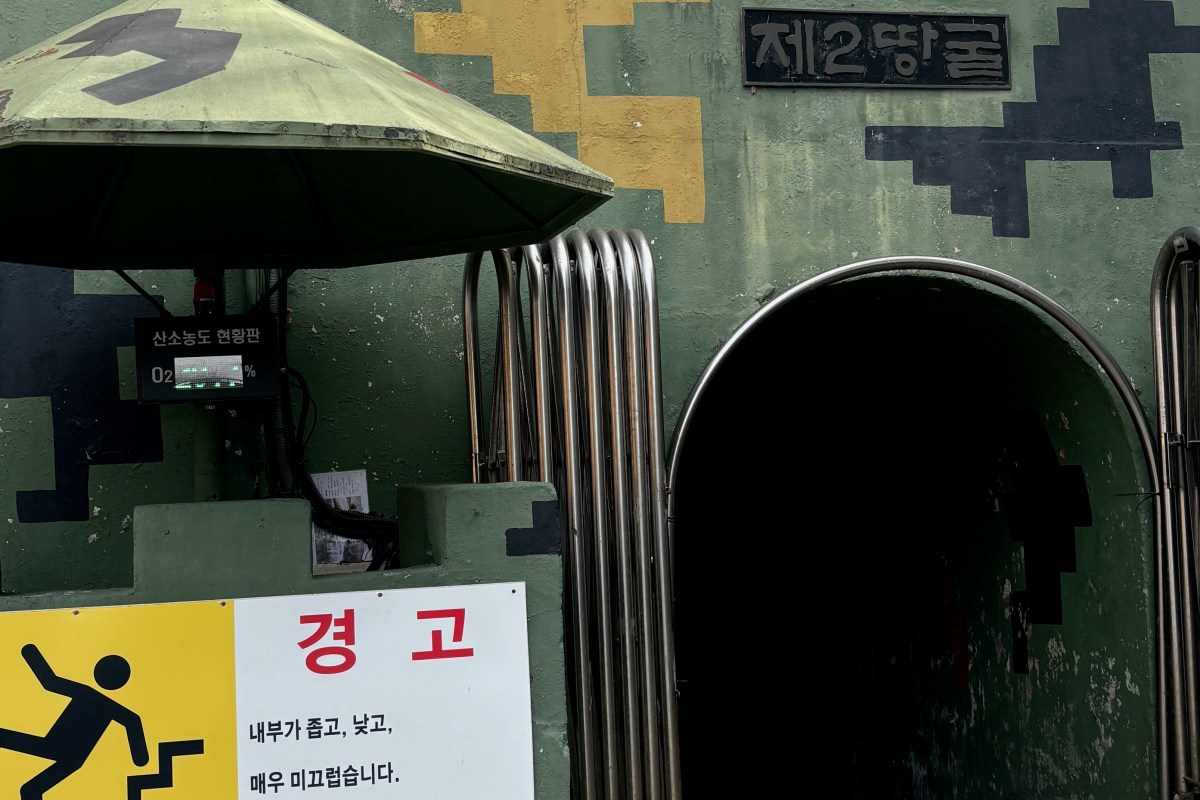
Back on the bus and off to our second stop, the “2nd Infiltration Tunnel” and, unexpectedly, a Crane centre (the bird variety) which we had a look around whilst Lucy sorted out some admin. The tunnel is one of four constructed by North Korea, intended for a surprise attack. The information in the visitors centre explained that some South Korean soldiers heard banging noises leading to the discovery of the tunnel in 1975, which had already been abandoned. It’s about 2m by 2m and could apparently accommodate up to 30,000 armed soldiers per hour, along with vehicles, artillery and tanks. I’m not so sure about the tanks – I soon understood why helmets were mandatory, as the ceiling is really low in places and the only sound was that of people bumping their heads every minute or so.

Crane Centre

Strictly no photos were allowed inside the tunnel, but it’s fairly well lit (the artificial lights allowed plants to grow despite the dampness). Our guide said there was some type of mineral on the ceiling – I forgot exactly what, but it’s meant to be lucky to touch it – but all I touched was slime. There are some benches for weary tourists at the deepest point, after which the tunnel is barricaded off and you need to turn back. It’s a bit surreal to consider that if you did continue on, you’d surface somewhere in North Korea, which presumably wouldn’t be a tourist attraction. Or would it?

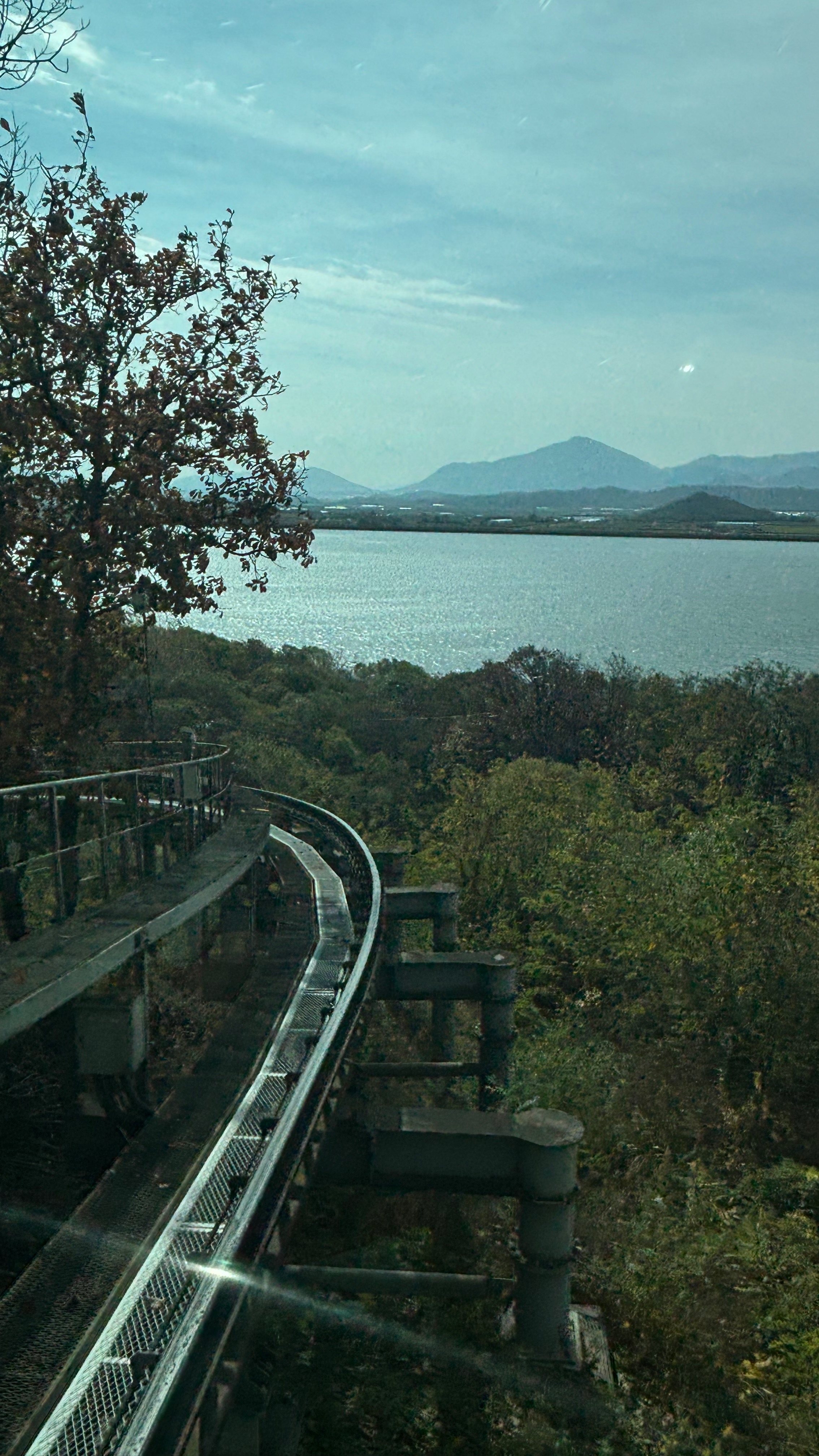
This day trip was 10 hours long (another common theme with the bus trips) and included a basic buffet lunch. Eventually we made it to the highlight of the trip and main reason for coming, the Peace Observatory. Lucy and Joey warned us not to take any photos of the South Korean guards, who would apparently all look very young (this was true). After a short train/cable car ride up, we all filed into a cinema style room (no photos inside either) and watched a short video which could itself be described as propaganda with it’s horror music style soundtrack. Positioned around the floor to ceiling glass windows were telescopes, some with digital screens trained on the DMZ and beyond into North Korea. We were told that whilst no photos were allowed outside either, nobody would check our phones which could be taken as encouragement. The adolescent looking soldiers helped focus the lenses on what was described as Propaganda Village – a village on the North Korea side which they say is fake. I did spot a moving truck, and Joey got very excited at a blob she said was “a North Korean”. She said this like it was some type of rare exotic species. I wondered were there lenses trained on us from the other side? Outside was even more surreal as over the wind I could hear a message being broadcast very loudly from the speakers, which the soldiers said was a message of peace. I have no idea what it was, as it was in Korean. But I found it fascinating wandering around the terrace, using the telescopes to look past nomads land. I would be slightly wary of posting any footage on social media, even if I had taken any.

Tanks outside the visitor’s centre (spot the name tag)

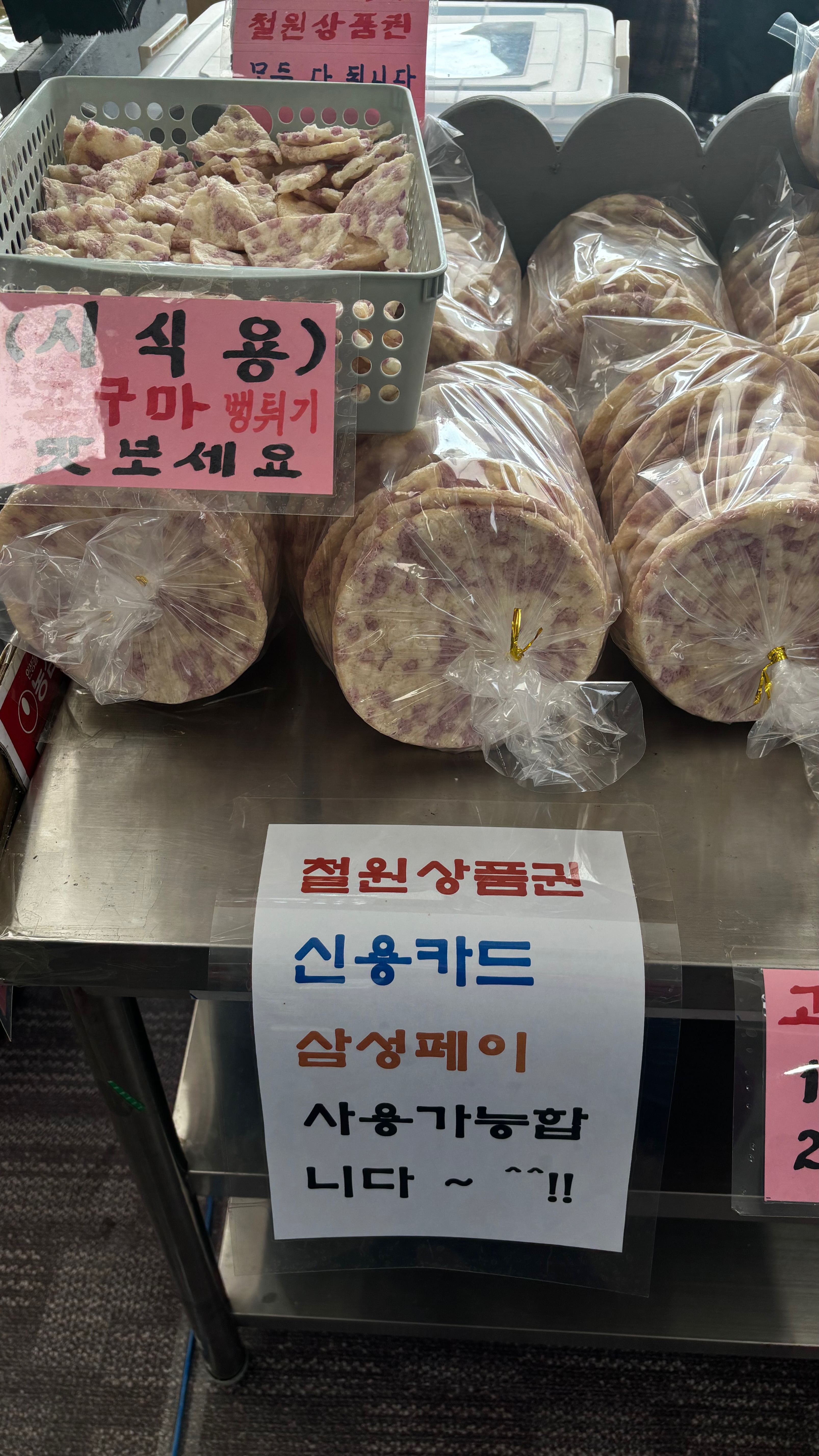
After some photos with the tanks and a visit to the shop selling 10kg bags of rice – also free green tea and samples of purple rice cake (this is prime rice growing territory) – off we went to yet another stop, the abandoned Woljeongri station. This is the now dilapidated last train stop before the border. It was a great photo opportunity and fairly eery with the remains of a carriage just rusting away on the tracks, which now lead to nowhere and the distant sound of K-Pop being broadcast from the South Korean speakers.
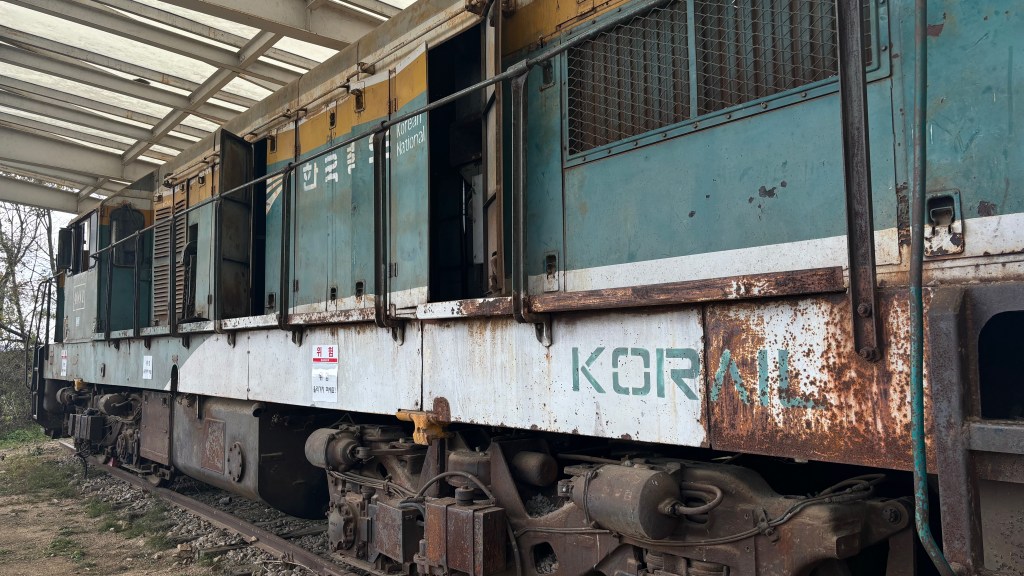
Train to nowhere
Korean K-Pop music in the background

Not far from here, and the final stop on the tour, is the last building constructed in North Korean architectural style, the Korean Workers Party Headquarters. Constructed in 1946, the three story building is falling down but there was still a a team of gardeners tending to the bushes. I didn’t get any more information on this, but imagine it’s an influencer’s dream photo spot in the Spring.

Cheorwon Korean Workers’ Party Headquarters

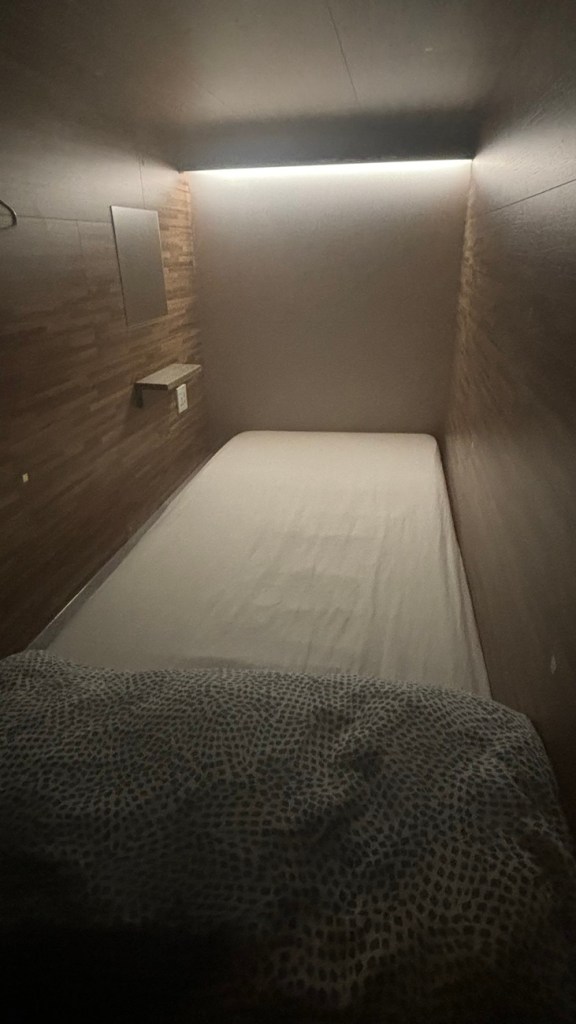
Finally it was back on the bus and a couple of hours drive back to Seoul. It was certainly an eye opening day, and once more it was too late to find a proper meal. These long days are tiring – I managed a walk around the night market in Myendong and a cheap veggie spring roll before retreating to my pod for some sleep before my morning flight to the South Korea’s answer to Hawaii, Jeju Island…

Dinner

Mad Dash to Seoul (South Korea Part One)

The idea of a two week trip to South Korea was a last minute one, even by my standards. I have wanted to visit South Korea for a long time and imagined I’d spend at least a few weeks exploring this relatively small country as part of a bigger trip to Asia – but with two weeks to wait before starting a new job, staying at home was never an option. I have never planned a trip so quickly, booking a flight that departed just a few days later.

Map of Seoul

I got myself an old fashioned guide book and did some very quick research on the main areas in Seoul. Next was accommodation – budget wise I didn’t want to spend more than £40 per night as I ended up spending more than expected on flights (who knew the £350 return flights on Skyscanner didn’t actually exist 🤦🏻‍♀️). What was available within that budget at three days notice over the weekend was a dorm bed in the Seoul Cube Jongno, located in the prime area of Jongno-Gu meaning I could walk to a lot of places on foot.

First impressions

On that note, this blog is usually just for friends and family to keep track of what I’ve been up to but in my rapid research I came across a lot of information that might actually be useful, so I have decided to make it a bit more informative this time! Scroll down if you have no intention of visiting ever. Things to be aware of:

  • There is a name in South Korea for hidden cameras and miniature spy cameras in women’s toilets, changing rooms and hotels and it’s called “molka”! Probably best not to go for one of the cheap “love motels”.
  • Google Maps does not work properly in Korea for navigation – you need to download the “Naver Maps” app and register as a user before you can save places to favourites. This often means using Google maps to find the Korean name then entering that into Naver to get directions.
  • Get an eSIM so you can navigate on the go – “Saily” is working well for me. I’m all for going old school and having a break from being online but otherwise it’s going to be very hard to get around in South Korea.
  • Uber does in fact work but it’s worth downloading the Korean taxi hailing app “Kakao-T” as well.
  • Travelling on buses is easy but you need to buy a “T-card” at a convenience store and top it up with cash also at the convenience store before you can tap on and off the buses. The average ride costs ₩1500 – I messed up the money and put on 70,000 instead of 7,000 so I can travel for a very long time. Or I can spend it on weird and wonderful items in the 7/11 or failing that apparently you can get a refund of the balance at the end of your trip.
  • Flying to Jeju Island is surprisingly cheap and worth it if you don’t want to spend a day travelling down by bus and ferry (£30 including checked baggage), but flights do actually get booked up particularly over the weekend.
  • Download Korean into Google translate so you can use it offline. Waking up to a Public Safety Alert message on your phone is a lot less scary when you can immediately translate it and understand that the earthquake was a long way away!
Welcome to Seoul

After leaving home on Friday morning, after a couple of hours stopover in the ultra modern Qatar airport and two long haul flights, I arrived on Saturday evening at Incheon International Airport. There are LOTS of buses and trains from the airport to the city. I was just too tired after 24 hours of no sleep to figure it out so I took the easy option of an Uber, well worth the £30 at night for over an hours drive and no hassle.

If someone managed to fit a spycam in here, so be it!

The driver dropped me at the address but I couldn’t see the hostel anywhere. Then I realised you need to look up in Seoul – everything is multi story. I still needed help to find the entrance, which was through a 7/11 shop.

The Seoul Cube hostel was very clean and very quiet, with women only dorms – much appreciated when powering through jet lag means going to bed at 9pm. I was so tired I had a packet of crisps for dinner and managed a bit of polite conversation with some other travellers before going to my pod.

This hostel has A LOT of rules. The most annoying one is that you can’t take your luggage into the bedroom so everyone unpacks on the kitchen floor. You’re also under CCTV in the common area and at constant risk of having the police called on you – strictly no alcohol here, no opening the fridge after before 07.00 or after 10.00 and definitely NO fraternising with the opposite sex. All of this contributes to a general lack of atmosphere but I didn’t have time to hang around the hostel anyway so it made no difference to me.

The “stream”

On my first morning after a great nights sleep in my pod I headed straight to the closest Tourist Information – there was no point asking any questions in the hostel as they had another sign on the wall essentially stating that they are not tourist information so don’t ask. The real Tourist Information were extremely helpful – they gave me a map and sent me off down the “stream” in the direction of somewhere open to get coffee (most of the coffee shops in the area close for a “break” mid morning).

Hechi

The Cheonggyecheon stream runs 11km through the city and comes alive in the evening, conveniently passing by my hostel. It’s actually a restoration of the stream from the Joseon Dynasty spanning 1392-1910. On Sunday morning it was home to the Seoul Outdoor Library, with lots of chairs set up with a stack of books ready for people to enjoy, which looked extremely inviting.

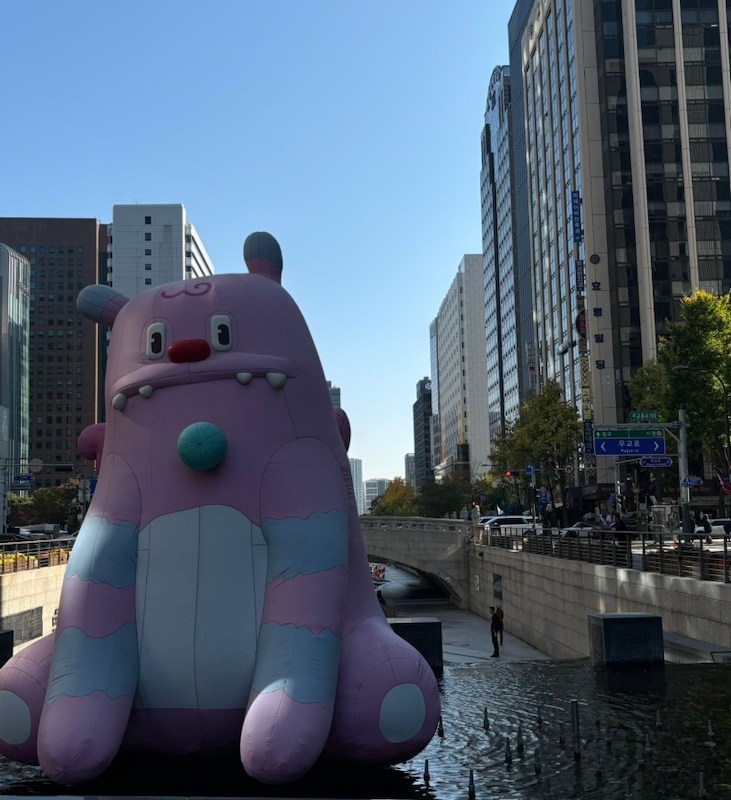
At the end of the stream is a huge bear like figure – this is Hechi, the mascot of Seoul. Mascots are popular here and this is one aspect that reminded me of Japan. Hechi sits overlooking the stream, infront of a huge speaker. There was some kind of rally going on with music blasting out and I couldn’t be sure where it was coming from.

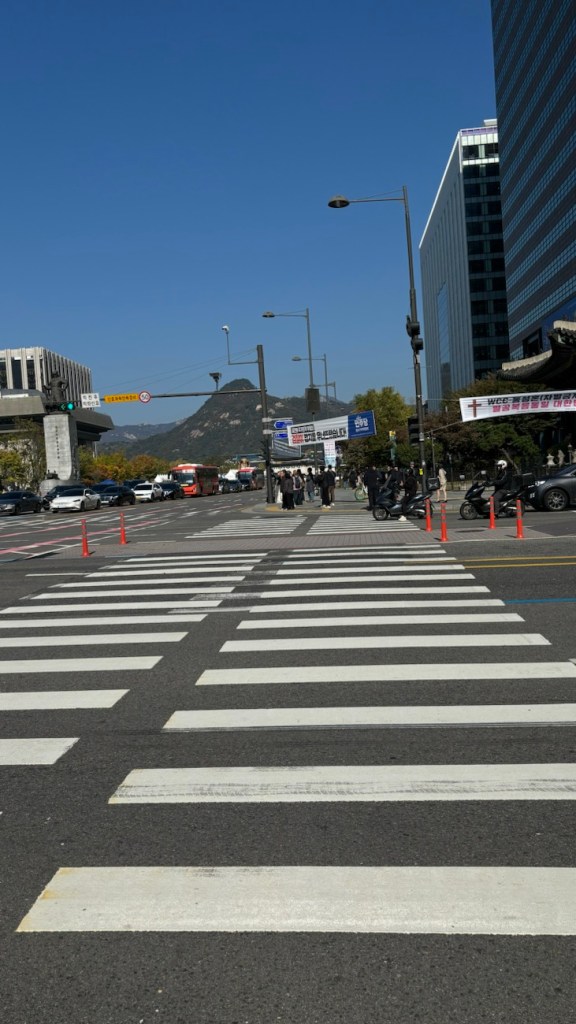
A short walk away from Cheonggyecheon is Gyeongbokgung Palace, meaning “The Palace Greatly Blessed By Heaven” and the largest of the five Grand Palaces. On my way there, Hechi and the outdoor library popped up again, this time with the Bugaksan mountain looming in the background.

My first impression of Seoul in the daylight was the merging of nature and urban. Mountains tower over crosswalks and skyscrapers loom in the distance behind palaces. Even when you’re in the midst of the city, a temple appears.

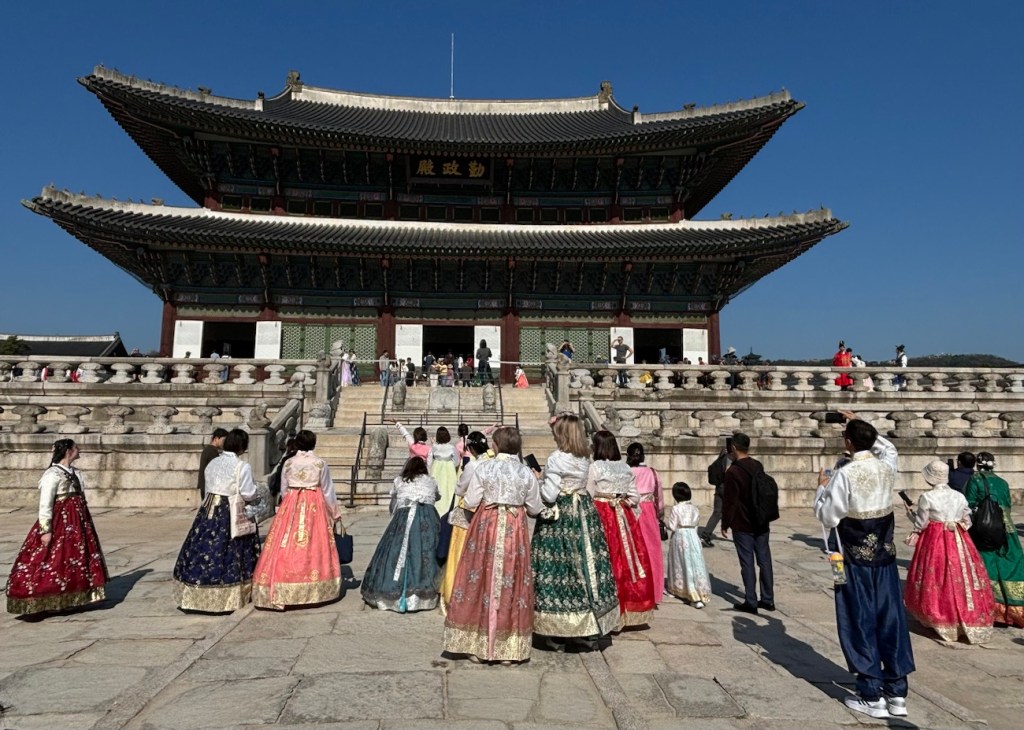
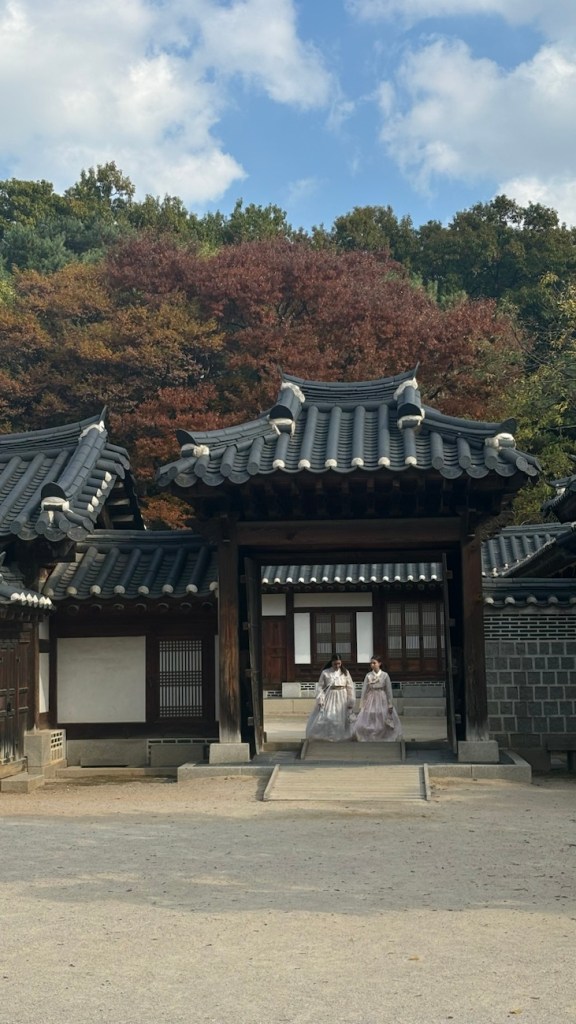
And the first thing that hit me when I entered the palace grounds through the Gwanghwamun Gate was the number of people in costume. This is positively encouraged in Seoul – you get in for free if you don the traditional costume known as Hanbok. Meanwhile I wandered around in my jeans and failed to get a good photo from anyone that I asked. Probably they make more effort for the Hanbok.

Inside the main palace

It’s a big complex of temple buildings, historically it acted as a small city, including separate King’s and Queen’s residences. The original palace dates back to 1395 and was the main royal palace of the Joseon dynasty. As well as the home of the royal family it was also the seat of government.

Timeline of events

A brief history; All of the royal palaces were burned down during the Japanese Invasion of 1592-1598. In fact Gyeongbokgung Palace was left derelict for over 270 years and reconstruction began in 1867 with over 500 buildings. It was then torn down again in the Japanese Occupation and replaced by a huge Japanese Government building. Further restoration has been ongoing again since 1900 with the Gate and the residences of the King, Queen and Crown Prince being restored to their original state. That’s most of the history I gleaned from the signs around the palace – anything more is best found on Wikipedia.

Entering the palace

I can’t take in too much information at once so I usually resort to taking photos of signs in the hope I’ll come back and read them at some point – here is one of them.

It’s definitely a good idea to learn some basic words in Korean and it’s much appreciated by the local people. Unfortunately this trip was so hurried that I only managed to half remember “thank you”. Something I regretted when I accidentally stepped on an old Korean man’s (full) coffee cup at the lake and was unable to even apologise properly. He did not see the funny side.

One of my favourite views
Autumn colours

Coincidentally autumn is one of the best times to visit South Korea as the fall foliage is in full swing. Everything is orange and green and brown which only adds to the beauty of the temples.

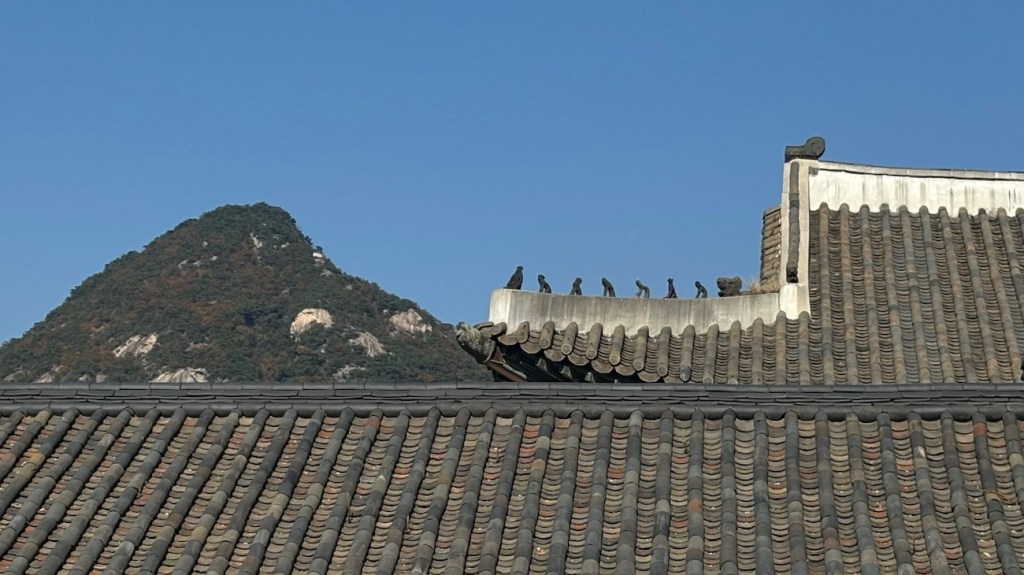
The animals on the roof are placed there to protect the building
Modern city meets ancient dynasty

There are some free tours of the palace in English but I had just missed one and didn’t want to wait. It would probably be useful as there are so many corners to explore. A couple of hours wandering around was enough for me before I got hungry – many restaurants in Seoul also “take a break” between 15.00-17.00 so I went in search of a vegan friendly lunch while I could. I didn’t actually end up in the vegetarian restaurant I was aiming for (still a bit confused as to what happened), but the place I found myself in had a vegan menu with the biggest pancake I’ve ever seen.

Apparently it can be hard to eat alone as restaurants here don’t like serving single portions but this seems to apply to the meat based Korean BBQs. A win for the veggies.

Spring onion style pancakemeant for sharing

There is so much to do, see and experience in Seoul you could easily spend a couple of weeks here. My aim in the afternoon was to make the most of my limited time and visit the cultural Bukchon Hanok Village. I should have paid more attention to the Tourist Helpers who were handing out leaflets on the street – this place is a residential area and “closes” to tourists at 17.00. I had just got there when I was met by people holding sandwich board style placards, encouraging us all to leave in a very smiley and nice manner. Bukchon Hanok will just have to go on the list for when I come back to Seoul at the end of this trip.

Resemblance to the real life helpers is uncanny

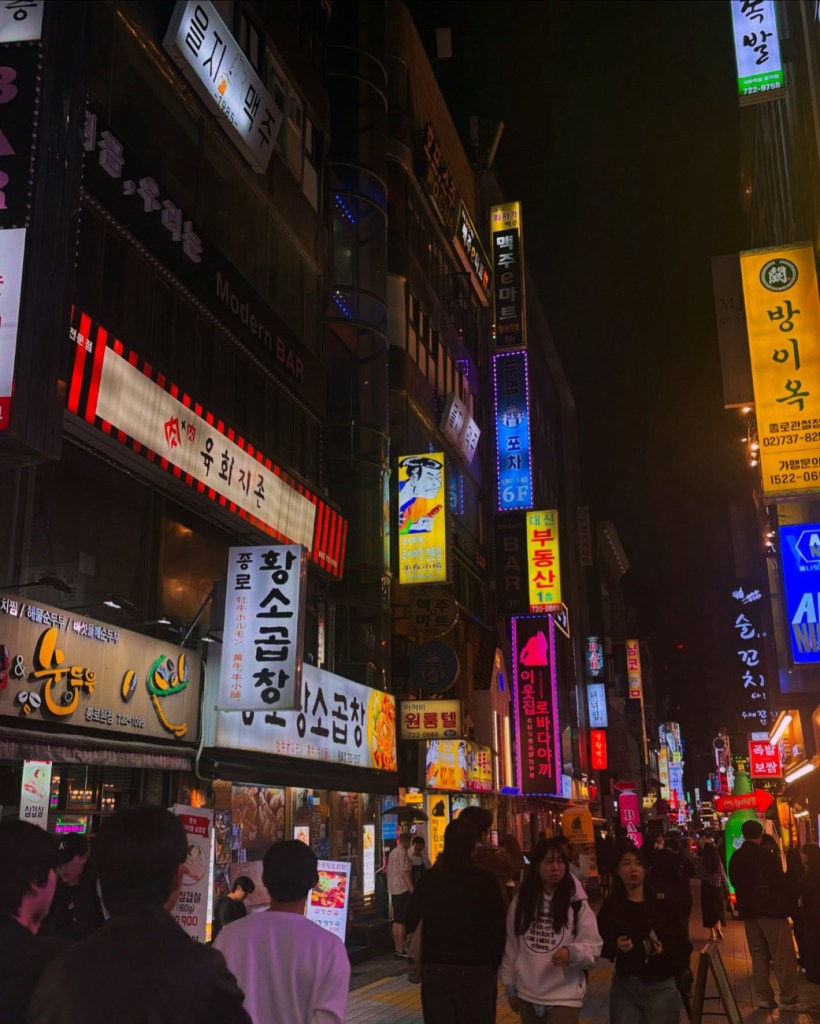
In the evening I took a walk over to Myeongdong with it’s neon signs and late night shops and street market. This felt like the Seoul I had imagined in my head. I’ll need to dedicate some time for shopping at the end of the trip as there is a whole K-Culture that I’ve not been aware of – K-Pop (Gangnam Style is just the beginning), K-Drama, K-Beauty…

Myeongdong

Seoul at night is beautiful and it’s a safe city. I could have walked for miles but I had to be up at 5.30am the next day for my DMZ tour. I will be breaking the hostel rule of “no alarms in the dormitory” for this one. Visiting the DMZ area – the “De-Militarised Zone” – was something I really wanted to do, where you walk through one of the infiltration tunnels and then look at North Korea through binoculars, with a suspension bridge visit thrown in for some light relief.

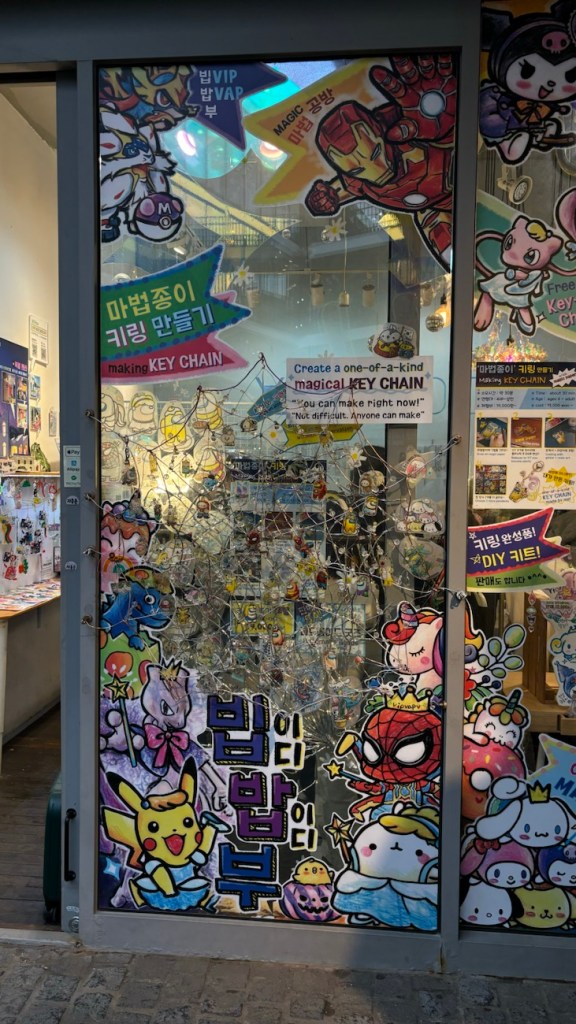
Make your own keychain
K-Pop themed sweets

Next stop, as close to North Korea as it’s possible to get…